After a successful fundraise through Crowdcube, we can still accept new investment from qualified HNW and strategic investors.
Please use the form below to contact us if you are a qualified HNW or a strategic investor.
Recycling Technologies welcomes enquiries and dialogue with potential investors, funding bodies and institutions. For general enquiries, we have prepared answers to the most frequently asked questions. Should you need further information, please don’t hesitate to contact us using the form below.
In a world where only 10% of plastic waste is recycled, Recycling Technologies is well positioned to create significant value from plastic waste for its investors, customers and society in general.Stephen Pascoe
Finance Director, Recycling Technologies
Register Interest & Investor Enquiry Form
Frequently Asked Questions
In what way am I able to invest in Recycling Technologies?
The company is looking to raise the capital through strategic investors, angel investors, venture capital, debt and other government funding sources. The strategic investors may also include companies from the petrochemical and waste industries.
Additionally we welcome investments from retail and everyday investors. In the past, we have offered such shareholders access to shares through third-party facilities such as www.crowdcube.com and www.syndicateroom.com.
When is the next investment round?
We are currently in discussions with further strategic partnerships and will be launching a retail investment round during Autumn of 2018. To be informed about this next and future investment opportunities please complete the investor form below.
Where can I get further details such as a business plan?
As part of each investment round, and in line with the nature of the investor enquiry, we provide an investor memorandum under NDA.
What type of Government grants have you received, and what is their value?
Up until March 2018, Recycling Technologies has received £4.4m in total grant funding from Regional Growth Fund, Department for Business, Energy & Industrial Strategy (formerly DECC), Innovate UK, H2020 and Zero Waste Scotland.
We have also received grant assistance from universities of UWE, Surrey, Sheffield and Royal Academy of Engineering.
These grants support R&D and address specific product and engineering challenges and enable access to research, training, and consultancy.
When is the next AGM?
Our AGM is held in during the first quarter of each year.
Do your investment rounds attract EIS tax options?
Yes, each investment round has so far been eligible for EIS. We will provide information about future rounds as it becomes available.
Who should I contact if I have a question about investing in Recycling Technologies?
Please use the investor query form below.
What is the invested money and funds raised being used for?
Shareholder and grant funding is being used to fund Recycling Technologies’ own projects and plans for sales roll-out for the first plants. A full break-down of funding requirements are available to prospective investors. Please leave your details below together with the nature of your interest in the company.
What are the different share options available to investors?
Recycling Technologies has two share classes: ordinary shares with voting rights and B shares without voting rights.
How do you keep existing investors informed?
Recycling Technologies has an Investor Director who reviews and monitors the business from a shareholder perspective. Each quarter the Investor Director prepares and sends a Shareholder Update outlining progress and information relevant to shareholders.
How can I find out about your next investment round?
Recycling Technologies produces a regular newsletter called Waste Matters providing updates about the company. People on this list are automatically informed at an early stage of planned investment opportunities. Please register to receive these updates.
What is the mass yield of each Machine?
The yearly capacity of the RT7000 machine is 7000 tonnes (dry weight basis) of Residual Plastic Waste. The expected yield of each plant is 75% which produces 5,250 tonnes of waxes and oils, we call Plaxx®, which can be used in wax and new polymer production. The remaining 25% which is not converted to oils and waxes forms a light hydrocarbon gas which is used to fuel the process.
Have you actually built the machines?
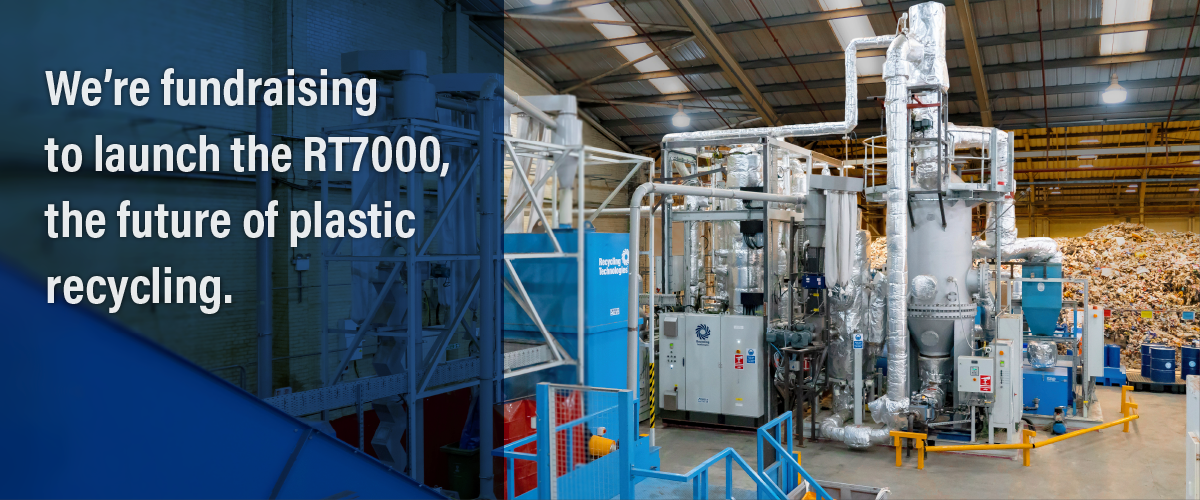
The business model is to assemble machines (RT7000s) in a factory and sell then around the world. We have built and run a “pre-production” machine that we call the Beta Plant, photos of which can be found on the website – www.rtech.co.uk.
Does your technology work?
The Beta Plant works and has been demonstrated to a number of interested parties including politicians, brands and retailers, waste companies, and leading global petrochemical companies.
Have you sold them?
We are not intending to sell the first dozen RT7000s coming off the production line. Rather, we plan to build, own and operate them ourselves at waste sites in the UK and the Netherlands. We will use this opportunity to gain operational experience, refine the machine technology and establish a training fleet prior to selling machines.
When is cash beginning to flow?
When Plant #1 has been built and commissioned, so Q3/4 2019. This will be part of the Project Beacon in Perthshire, Scotland, which combines our chemical recycling with mechanical recycling to realise vastly improved recycling rates.
What type of plastics are you able to recycle?
Our machine takes plastic waste that current technologies have considered unrecyclable. After shredding, drying and the removal of grit, glass and biomass, the material is fed into a high-temperature chamber. In the absence of oxygen, heat cracks the long carbon chains of plastic producing a vapor which is condensed into a range of Plaxx products.
Due to the chemical nature of our process, the RT7000 is able to tackle plastics currently considered unrecyclable: films, food trays, laminated plastics such as crisp packets and even black plastic.
What can the product, Plaxx, be used for?
The mass yield is 75%, meaning that 75% of the output is the recycled oil/wax (Plaxx), 2% is solid waste (disposed of by waste management companies) and the remaining 23% is non condensable gas that is recirculated back into the process and used as fuel to heat the process.
Of the 75% Plaxx produced, approximately:
- 30% is Plaxx-50, marketable as waxes
- 30% is Plaxx-30, marketable as petrochemical feedstock or Low Sulphur Marine Gas Oil or Heavy Fuel Oil
- 40% is Plaxx-16 + Plaxx-8, marketable as petrochemical feedstock for new plastic production
How energy efficient are you?
We estimate that the energy efficiency of the process to be 85%. During start-up, the process will need propane to supply the energy to get the system up to temperature and initiate the cracking process needed for the pyrolysis reaction. But once hot, energy supply is self-sufficient as the heat energy is sourced by using the light hydrocarbon gases (LHG) that are formed during the pyrolysis of plastic waste but are not condensed into Plaxx. LHG is equivalent to LPG, a clean burn fuel.
How do you deal with PVC and Chlorine content
Our initial plants will take Residual Waste Plastic left over after municipal Material Recycling Facilities (MRFs) have mechanically removed what they can for recycling. There can be a small amount of PVC in this stream. Our facility will sort this further to extract PVC as far as is practical. Any PVC that gets through this process will create a low level of Hydrogen Chloride in the LHG which is easily removed from the fuel and will have a negligible effect on emissions.
What is the environmental impact when running the machine?
When we crack plastic waste, 75% of the available hydrocarbons are converted to Plaxx and the rest is converted into light hydrocarbon gases. These gases are then used within the process as the source of heat energy needed for the cracking.
Our process is an alternative to landfill and Energy from Waste incineration plants for solving the problem of Residual Plastic Waste. In comparison to Energy from Waste, even after taking into account the CO2e savings from electricity generation, the RT7000 saves a net 1.8 tonnes of CO2e for each tonne of plastic waste processed. Based on this, in a year an RT7000 would save 12,600 tonnes of CO2e emissions by diverting that plastic from Energy from Waste plants. With just fifty machines installed in the UK, the CO2e emissions savings will be the same as taking 135,000 cars off the roads every year.
Are you supporting the Circular Economy?
The primary output product, Plaxx, is a valuable petroleum commodity that can be used in the production of new plastics, propelling plastics into the Circular Economy. Chemical recycling allows plastic waste to be returned into virgin-quality polymers, enabling their use in all applications, including food grade packaging.
Recycling Technologies is working with the Ellen MacArthur Foundation on Project LODESTAR, a pioneer project being undertaking by the New Plastics Economy.
Led by Recycling Technologies, Project LODESTAR is a collaboration of a number of global companies seeking to develop a blueprint for an optimal, regional, advanced Plastic Reprocessing Facility. This design combines standard and enhanced mechanical reprocessing with chemical recycling as provided by Recycling Technologies’ RT7000 machine, to achieve vastly improved recycling rates for all plastics.
Founded by the Ellen MacArthur Foundation & the World Economic Forum, the New Plastics Economy is spearheading the global drive to ensure plastic becomes a sustainable material in line with its objectives for a Circular Economy.
Recycling Technologies has an important role to play in helping the signatories of the UK Plastic Pact achieve their goal of using only ‘100% recyclable, reusable or compostable plastic packaging by 2025‘.